
Instant Adhesives in Electronics Manufacturing: Fast Bonding Solutions for FPC, Magnetic Cores and Plastic Housings
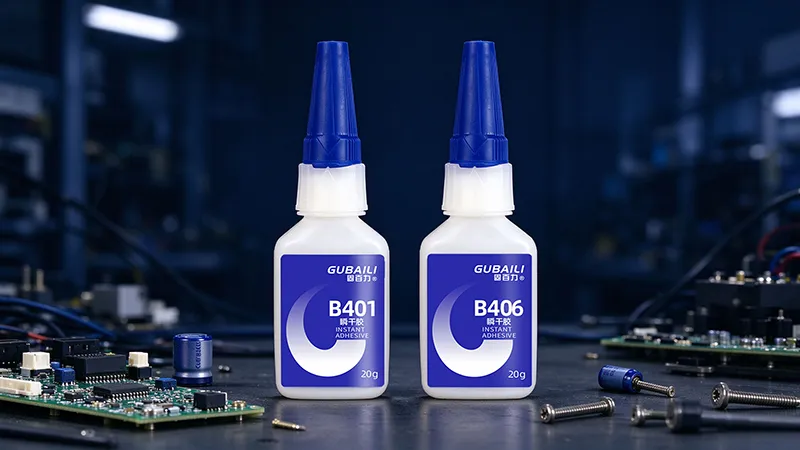
Instant Adhesives in Electronics Manufacturing: Fast Bonding Solutions for FPC, Magnetic Cores and Plastic Housings
Electronics assembly has a distinctive set of requirements for adhesives: small products, many components and fast line takt times; thin bond lines that do not encroach on electrical clearances; no volatiles that could contaminate contacts, lenses or display panels; and no solvent attack on the many plastic parts (ABS, PC, PS). Instant adhesives (alpha-cyanoacrylates) have become a common auxiliary bonding material in electronics assembly precisely because they meet these constraints.
1. Why the Electronics Industry Uses Instant Adhesives Extensively
Compared with threaded fastening, ultrasonic welding or double-sided tape, instant adhesives offer clear advantages at electronics workstations:
- Fast fixturing: initial positioning in seconds to tens of seconds, matching line takt time;
- One-component: no metering, mixing or heating—just dispense;
- Thin bond line: lap gaps are typically kept below 0.1 mm, preserving electrical clearance and creepage distance on small components;
- Insulation: the cured adhesive is an insulator with high volume resistivity and does not affect electrical insulation;
- Solvent-free: no toluene, acetone or other solvent residues, so contact contamination is relatively low.
2. Typical Workstations
2.1 FPC / FFC Flexible Cable and Connector Fixing
After assembly, flexible cables often need strain-relief fixing at the root to prevent wire breakage or poor contact from bending. Instant adhesives are used for:
- Fixturing FPC / FFC cables near the PCB solder area;
- Routing and fixing wire harnesses to housings;
- Strain relief at connector tails.
This workstation requires a flexible, non-brittle bond line and no adhesive bleeding onto contacts.

Cable and connector bonding workstation
2.2 Transformer, Inductor Core and Coil Bonding
Ferrite cores in switching power supplies and filter inductors must be fixed face-to-face during assembly to prevent displacement and noise from vibration:
- EE / EF / RM core center-leg bonding;
- Fixturing coil bobbins to cores;
- Auxiliary fixing of outer windings.
Instant adhesives cure quickly without affecting magnetic performance, making them a common choice for core bonding. Porous ferrite absorbs more adhesive, so the amount applied should be slightly higher than on smooth metal surfaces.
2.3 Speaker, Receiver and Microphone Assemblies
Electroacoustic components have high appearance and precision requirements:
- Bonding magnets to T-yokes / front plates;
- Fixturing diaphragms and voice coils;
- Assembling frames and housings;
- Fixing buzzers and microphone capsules.
These workstations are sensitive to "blooming" (a hazy deposit formed when volatiles condense on part surfaces), especially on transparent diaphragms, light-colored frames and metal surfaces. Low-blooming grades such as B406 are usually selected.

Close-up of speaker magnet bonding
2.4 Switch, Button and Knob Fixing
- Auxiliary fixing of tact switches and micro switches to PCBs;
- Mating button caps to switch stems;
- Fixturing knobs to encoder shafts.
2.5 Sensors and Small Components
- Housing assembly for photoelectric and temperature sensors;
- Fixing ceramic resonators and crystal oscillators;
- Auxiliary fixturing of Hall elements and IC surfaces.
2.6 Plastic Housings and Windows
- Auxiliary fixing after snap-fitting ABS, PC and PS housings;
- Bonding indicator lenses and display windows;
- Fixing nameplates and scale plates.
Note: PC (polycarbonate) and PMMA (acrylic) are stress-sensitive. Unreacted monomer in standard instant adhesives can cause crazing or cracking. For appearance parts, run a small trial first or choose a low-stress grade.
2.7 Component Vibration Reinforcement
In vibrating environments (automotive, power tools, industrial equipment), larger resistors, capacitors, inductors and connectors can suffer solder-joint fatigue. A small dot of instant adhesive between the component body and the PCB provides mechanical reinforcement; the dot must not cover the pin pads.
3. Special Requirements in Electronics
In addition to strength and cure speed, consider:
| Parameter | Requirement | Reason |
|---|---|---|
| Insulation | High volume resistivity | Does not affect circuit insulation |
| Volatiles | Low odor, low fogging | Avoids contaminating lenses, contacts and LCDs |
| Blooming | Low-blooming formula | Essential for transparent and appearance parts |
| Plastic compatibility | Does not attack PC/PMMA | Avoids stress cracking |
| Silicone content | Silicone-free | Prevents interference with conformal coating, soldering and printing |
| Humidity/heat resistance | Passes 85°C/85%RH | Common reliability condition for consumer electronics |
| Thermal shock resistance | -40°C to 85°C cycling | Required for industrial and automotive applications |
4. Substrate Compatibility
| Substrate | Bonding Difficulty | Recommended Approach |
|---|---|---|
| ABS, PS, PVC | Easy | B401 / B406 direct use |
| PC, PMMA | Moderate | Verify cracking first; choose low-stress grade for appearance parts |
| Ferrite, ceramics | Easy | Increase adhesive amount for porous materials |
| Metals (steel, aluminum, brass) | Easy | General-purpose B401 suitable |
| NBR, neoprene rubber | Moderate | More consistent with a primer |
| PA nylon, POM acetal | Difficult | Dedicated primer required |
| PE, PP, silicone rubber | Very difficult | Surface treatment required (plasma/priming); standard instant adhesives bond poorly |
5. Application Process
- Surface cleaning: Remove oil, mold release and dust with isopropyl alcohol before assembly, and allow to dry before dispensing.
- Adhesive amount: One drop (about the size of a mung bean) is sufficient; thinner bond lines give higher strength. Excess adhesive slows curing and increases blooming.
- Dispensing method: For volume production of small parts, use an automatic dispenser with a needle to control the amount; for small batches, the original precision nozzle bottle is sufficient.
- Alignment and pressure: After dispensing, align and join the parts, press for 10-30 seconds until initial set, then release; full strength requires about 24 hours.
- Environment: 20-25°C and 50%-60% relative humidity give suitable cure speed. Very low humidity significantly extends cure time; a primer can help.
- Ventilation: Maintain moderate ventilation at the workstation to reduce condensation of volatiles on part surfaces.
6. Common Problems and Solutions
| Problem | Possible Cause | Solution |
|---|---|---|
| White haze on surfaces | Excess adhesive, poor ventilation, high humidity | Switch to low-blooming B406, reduce adhesive amount, improve ventilation |
| Plastic cracking (PC/PMMA) | Monomer stress causing crazing | Use a low-stress formula and run a small trial first |
| Poor bond, pops off easily | Substrate is PE/PP/silicone rubber/POM | Use a dedicated primer or surface treatment |
| Cures too slowly | Cold, dry environment; porous substrate absorbs adhesive | Use a primer and raise ambient humidity |
| Squeeze-out contaminates contacts | Excess adhesive or off-target dispensing | Control the amount and use a locating fixture |
| Bottle nozzle clogging | Moisture enters after opening | Tighten immediately after use and store sealed under refrigeration |
7. GUBAILI Product Selection Guide
- B401 general-purpose: For fast assembly of ABS, PS, metals, ferrite and other general electronic small parts; suitable for most standard workstations.
- B406 low-blooming: For workstations sensitive to blooming, such as speakers, transparent windows, indicator lenses and light-colored appearance parts.
For actual selection, consider the substrate, gap size, cure-speed requirement and reliability test conditions, and validate with a small batch before going into production.
Conclusion
In electronics manufacturing, instant adhesives are not primary structural adhesives but highly efficient auxiliary bonding materials. Used at the right workstation with the right grade, they significantly improve assembly efficiency; the wrong substrate or too much adhesive can cause blooming, cracking and contamination. GUBAILI can provide selection advice and sample support based on your component materials and process conditions.