
Cylindrical Retaining Compounds in Machinery: Radial Fixing Solutions for Bearings, Bushings and Gears
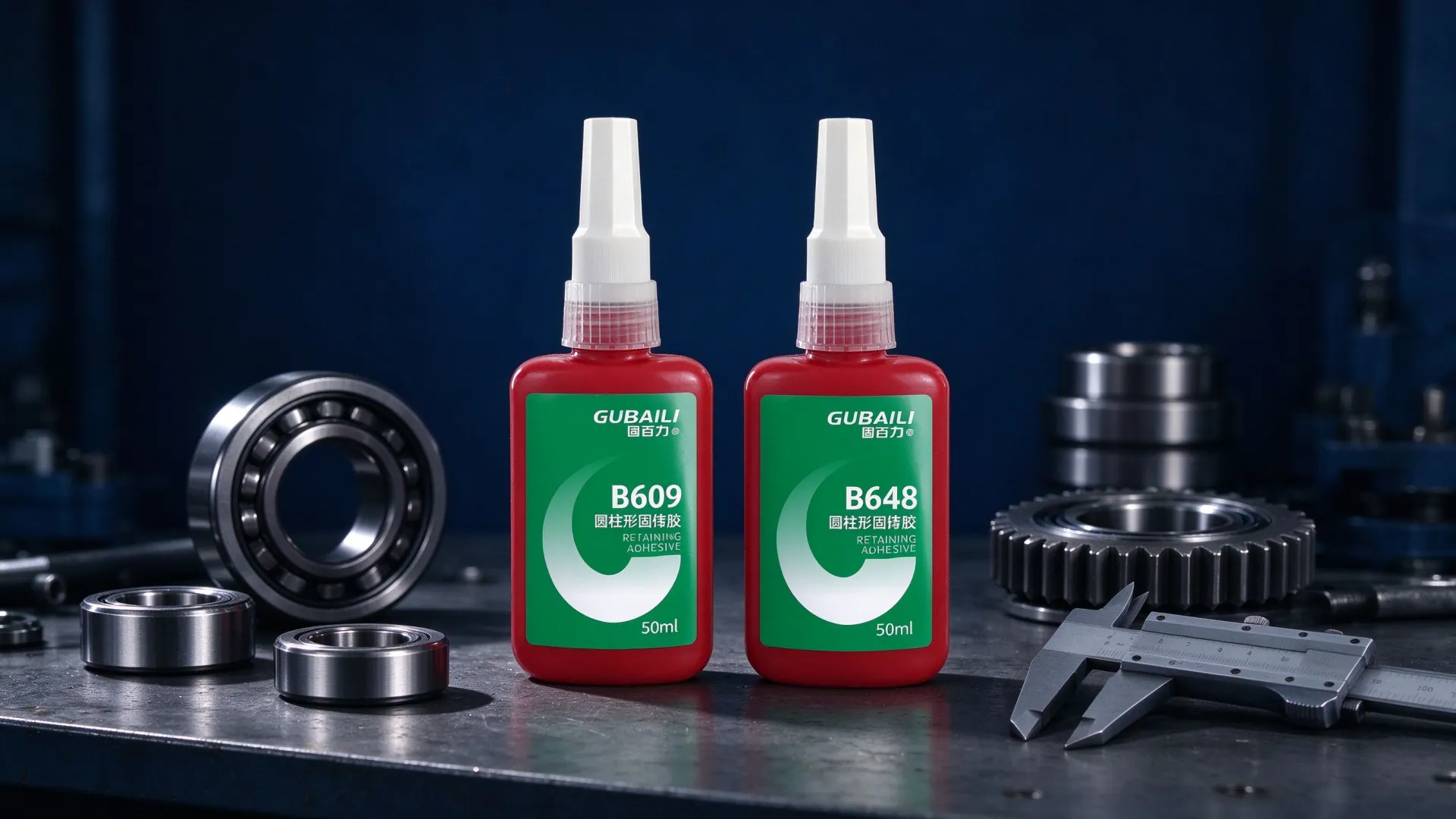
Cylindrical Retaining Compounds in Machinery: Radial Fixing Solutions for Bearings, Bushings and Gears
In machinery, cylindrical fits between shafts and hubs, bearing inner rings and shafts, and bushings and housing bores have long relied on interference fits, keyed connections or pin fixing. Interference fits demand high machining accuracy and are difficult to assemble and disassemble; keyways and pin holes create stress concentration and can loosen or fatigue under long-term load. Cylindrical retaining compounds (anaerobic) fill the fit clearance and, once cured, carry shear stress—an alternative for these cylindrical fits.
1. How They Work and Their Advantages
Cylindrical retaining compounds are anaerobic adhesives: stable in liquid form when exposed to air, they polymerize and cure at room temperature when applied to shaft and bore mating surfaces, isolated from oxygen and in contact with metal, forming a hard resin layer. Their direct benefits include:
- Filling microscopic gaps: resin fills the microscopic peaks and valleys, changing localized point contact into full-circumference surface contact;
- Reducing machining accuracy requirements: reliable load transfer with clearances relaxed from 0.05-0.15 mm to 0.10-0.25 mm, reducing grinding time;
- Uniform load and anti-loosening: eliminating keyways gives a more uniform stress distribution and avoids loosening and fretting wear under impact loads;
- Corrosion protection: the adhesive layer blocks moisture and contaminants from the mating surface, preventing long-term corrosion and seizure.
2. Typical Applications
2.1 Bearing Inner Ring to Shaft
This is the most common use of cylindrical retaining compounds: fitting rolling bearing inner rings to shafts in motors, pumps, fans and reducers. Adhesive is applied to the shaft journal or bearing bore and cures after press-fitting, preventing the inner ring from creeping and spinning on the shaft.

Applying retaining compound to the bearing inner ring mating surface
2.2 Bushings, Sleeves and Housing Bores
Plain bearing bushings, bronze sleeves, seal seats and guide sleeves are fixed with retaining compound after being pressed into housings or frames, preventing rotation and axial movement.
2.3 Gears, Sprockets, Pulleys and Shafts
Cylindrical fits of reducer gears, sprockets, pulleys and cams to shafts can eliminate keys or supplement keyed connections, especially in applications with frequent reversal and impact loads.

Reducer gear and shaft assembly workstation
2.4 Motor Rotors and Fan Impellers
For interference fits between motor rotor cores and shafts, and fan impellers and shafts, retaining compound reduces press-fit force and improves reliability. It is also commonly used to repair worn shafts during maintenance.
2.5 Pumps, Valves and Hydraulic Components
Cylindrical fits of pump impellers to shafts, pump housing bushings, hydraulic plungers, and valve sleeves to bodies both transmit torque and seal against media leaking along the mating surface.
2.6 Cutting Tools, Tool Holders and Mold Inserts
Cylindrical fits of milling cutter heads and tool holders to spindles, and fixing of mold inserts, guide bushings and mold bases, where high-precision positioning and no loosening are required.
3. B609 vs. B648 Selection Guide
| Product | Strength | Removability | Typical Locations |
|---|---|---|---|
| B609 | Medium | Removable with standard tools | Bearings, bushings and pulleys requiring periodic repair or replacement; small-clearance fits; light loads |
| B648 | High | Heat or a dedicated puller required | Reducer gears, heavy-duty bearings, pump impellers, shaft-hub fits under impact and vibration; parts rarely disassembled |
Selection principle: choose medium strength (B609) where maintenance disassembly is needed; choose high strength (B648) for heavy loads, impact and infrequent disassembly. Clearances within 0.10 mm can use the standard product; for clearances over 0.15 mm, choose a high-viscosity or large-gap grade.
4. Application Process
- Surface cleaning: Use a cleaner to remove oil, rust and old adhesive from the shaft journal and bore, and dry before applying.
- Application point: Apply adhesive evenly around the shaft mating section and on the bore wall, covering the full axial length of the fit.
- Assembly method: Press immediately after application, keeping force uniform around the circumference; do not rotate while pressing, as this can scrape off the adhesive.
- Initial set: Standard steel fits set in about 10-30 minutes, after which the part can be released; wait about 24 hours for full strength before loading.
- Disassembly: Medium-strength joints can be pulled with a puller; for high-strength joints, heat to about 150°C with a torch or heating sleeve and disassemble while hot.
- Storage: Store sealed in a cool, dry place and avoid adhesive residue at the nozzle curing in air.
5. Common Problems and Solutions
| Problem | Cause | Solution |
|---|---|---|
| Slips after press-fitting, will not transmit torque | Oil not removed, excessive clearance, insufficient adhesive | Clean mating surfaces thoroughly, use high-viscosity grade for large gaps, ensure full adhesive coverage |
| Does not cure for a long time | Passive metals such as stainless steel, aluminum alloy or plated surfaces | Use a primer or a grade designed for passive metals |
| Will not press in | High adhesive viscosity, excessive interference | Check fit dimensions, grind if necessary, use press equipment |
| Shaft breaks during disassembly | High-strength adhesive on a small-diameter shaft; no heating | Select strength by load and heat before disassembly |
| Worn-shaft repair does not last | Excessive wear (over 0.3 mm) | Repair out-of-tolerance wear by spraying or hard chrome plating before using retaining compound |
Conclusion
Cylindrical retaining compounds achieve full-circumference bonding by filling the fit clearance, making them suitable for radial fixing and torque transmission of bearings, bushings, gears and pulleys. Choose B609 or B648 based on whether maintenance disassembly is required, and combine with proper cleaning and press-fit practices to reduce machining costs and improve fit reliability. GUBAILI can provide selection advice based on fit dimensions, clearance and load conditions.