
Threadlockers in Automotive Manufacturing and Repair: Anti-Loosening Solutions for Engine and Chassis Bolts
Threadlockers in Automotive Manufacturing and Repair: Anti-Loosening Solutions for Engine and Chassis Bolts
Automobiles continuously experience engine vibration, road impact and thermal cycling while driving, and loosening bolted joints are a common source of failure. Traditional spring washers, lock tabs and nylon-insert lock nuts offer limited anti-loosening performance under long-term vibration. Threadlockers (anaerobic adhesives) fill the thread clearance and cure into a resin layer that consolidates the threaded assembly into one unit—a common anti-loosening solution in automotive manufacturing and aftermarket repair.
1. How Threadlockers Work
Threadlockers are anaerobic adhesives: stable in liquid form when exposed to air, they gradually polymerize and cure at room temperature when applied to thread clearances, isolated from oxygen and in contact with metal ions (iron, copper, etc.), forming a hard thermoset resin. They serve three functions at once:
- Fill gaps: fill the microscopic voids between thread flanks, eliminating lateral movement;
- Isolate the environment: prevent moisture and salt from entering the threads and causing corrosion and seizure;
- Transfer load: the cured adhesive layer shares part of the axial and shear stress.
2. Typical Applications
2.1 Engine Area
The engine bay combines high temperature and strong vibration; bolt loosening can cause oil leaks, noise or even mechanical damage:
- Oil pan bolts, valve cover bolts;
- Intake and exhaust manifold studs;
- Alternator, A/C compressor and water pump bracket bolts;
- Sensor, oil pressure switch and coolant temperature sender threads;
- Flywheel and clutch pressure plate bolts (high-load areas).

Applying threadlocker to engine-bay bolts
2.2 Chassis and Suspension
Chassis components directly absorb road impact and steering loads; loosened bolts affect alignment and handling stability:
- Control arm, steering knuckle and strut tower bolts;
- Subframe and stabilizer link bolts;
- Steering rack tie rod and lower control arm bushing bolts;
- Brake caliper guide pins and brake line fittings.
 Chassis suspension bolt assembly workstation
2.3 Transmission and Drivetrain
- Transmission oil pan and end cover bolts;
- Driveshaft flange bolts, differential bolts;
- Clutch release fork and release bearing set screws.
2.4 Brakes and Wheels
- Brake caliper bracket bolts;
- Wheel hub bolts must be tightened to OEM-specified torque; threadlocker is used only in specific repair situations;
- ABS sensor mounting screws.
2.5 Body Accessories and Interior
- Seat rail and seat belt mounting bolts;
- Mirror, license plate frame and interior sheet-metal screws;
- A/C line fittings and electronic module housing screws.
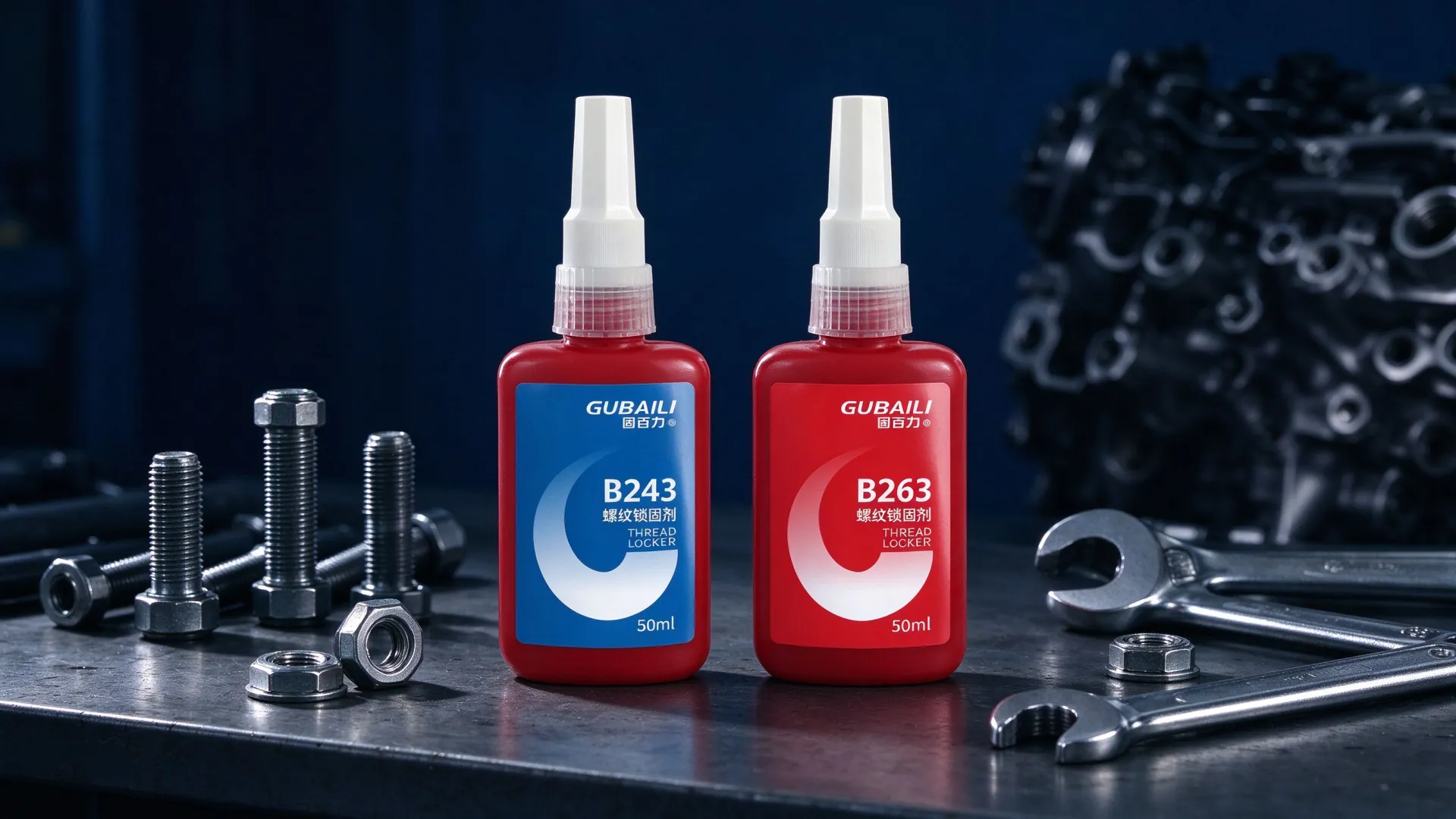
3. B243 vs. B263 Selection Guide
Automotive locations vary widely; whether later disassembly is required is the primary selection criterion:
| Product | Strength | Removability | Typical Locations |
|---|---|---|---|
| B243 | Medium | Removable with standard tools | Oil pan, valve cover, sensors, interior screws, bracket bolts and other parts requiring periodic maintenance |
| B263 | High | Heat or special tools required for removal | Main bearing caps, flywheel, clutch, critical chassis load-bearing bolts and other high-load parts rarely disassembled |
General principle: choose medium strength (B243) where maintenance disassembly is needed; choose high strength (B263) for long-term, heavy-load joints that are rarely disassembled. Standard steel threads from M6 to M20 are applicable.
4. Application Process
- Surface cleaning: Use a cleaner to remove engine oil, grease and metal chips from the threads; oil significantly reduces cured strength.
- Application point: Apply adhesive to the first few engaged threads of the bolt, or directly to the internal threads of the nut; full thread coverage is unnecessary.
- Assembly timing: Tighten immediately after application to the specified torque; wipe excess adhesive before it cures.
- Initial set: Standard steel threads set in about 10-30 minutes, allowing the next assembly step; full strength requires about 24 hours.
- Cure temperature: Curing is best above 20°C; in cold winter conditions, use a primer or allow a longer wait.
- Disassembly: Medium-strength joints can be loosened directly with a wrench; for high-strength joints, heat to about 150°C before disassembly to avoid thread damage.
5. Common Problems and Solutions
| Problem | Cause | Solution |
|---|---|---|
| Does not cure for a long time | Heavy oil on threads; passive metals such as stainless steel, zinc plating or anodizing | Clean thoroughly; use a primer on passive metals |
| Insufficient strength after curing | Excessive gap (over 0.15 mm), insufficient adhesive | Use a higher-viscosity grade for large gaps; ensure adhesive fills the engaged threads |
| Nut will not turn | Too much adhesive, crossed threads | Control the amount and ensure threads are aligned before tightening |
| Bolt breaks during disassembly | High-strength adhesive on too-small threads; no heating | Select strength by location and heat before disassembly |
| Bottle nozzle clogging | Air entering the bottle triggers polymerization | Close tightly after use and avoid adhesive residue at the nozzle |
Conclusion
Threadlockers are not a simple replacement for spring washers; they achieve chemical anti-loosening by filling thread clearances. In automotive manufacturing and repair, selecting B243 (medium strength, removable) or B263 (high strength, long-term locking) by location, combined with proper cleaning and application, effectively reduces failures caused by bolt loosening. GUBAILI can provide selection advice based on thread size, material and disassembly requirements.